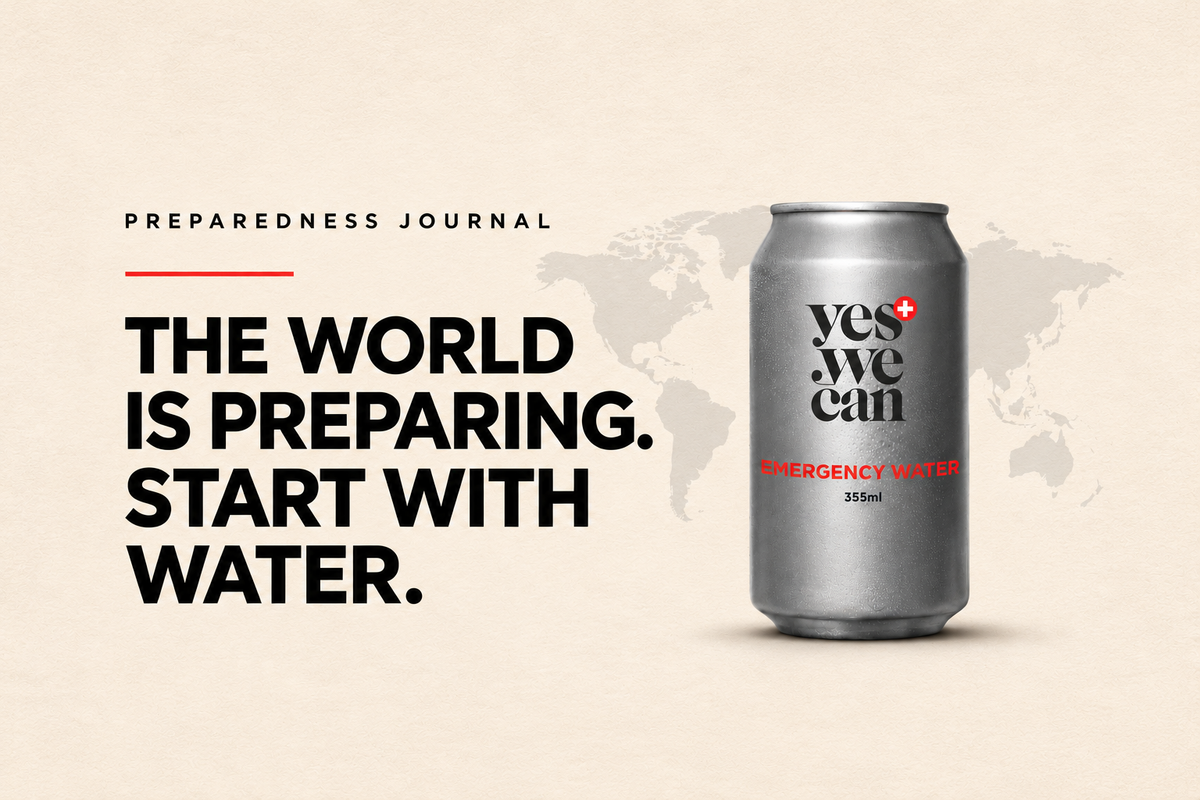
A message is appearing across government websites and public information campaigns: take a few simple steps now so your household can manage if everyday services are interrupted.
In the United Kingdom, a new “Be Ready” campaign encourages households to prepare for three days of disruption. In Europe, newly announced guidance focuses on the first 72 hours of an emergency. Sweden advises preparing for at least a week.
The details vary, but the practical question travels well: if the services you rely on stopped working, what would you already have at home?
For emergency water preparedness, that question starts with the tap.
Think about tomorrow morning. Drinking water. Breakfast. Taking medication. Filling the dog’s bowl. These familiar routines make it easier to picture what a useful water reserve needs to cover.
At Yes We Can Emergency Water, we believe readiness begins with decisions you can make today: count the people who depend on you, understand your needs and put a manageable plan in place.
Why preparedness is getting renewed attention
Recent announcements give households a timely reason to review their supplies.
On November 3, 2026, the European Commission presented new preparedness guidelines covering essential supplies for the first 72 hours, education, accessible planning and clearer risk communication. The guidance builds on its 2025 Preparedness Union Strategy. Read the European Commission announcement.
On October 22, 2026, the UK government launched its “Be Ready” campaign. Its advice includes keeping drinking water and non-perishable food at home, alongside simple actions such as registering for additional utility support where eligible. The campaign addresses temporary interruptions to services including power, water, phones and the internet. Explore the UK announcement.
Sweden’s guidance recommends planning for access to water, food, communication and heating for at least one week. It also encourages neighbours to prepare together and share resources. Read Sweden’s home preparedness guidance.
These recommendations have different histories and coverage periods. Together, they show how household readiness is becoming a more visible part of public conversation.
Use that conversation as a prompt to check your own arrangements, guided by the advice where you live.
Turn the headlines into a household water plan
An international announcement can feel far removed from your kitchen. A quick water check makes it concrete.
Look at the drinking water you currently have available. How many litres are there? How many people would share it? Could everyone reach it?
A few containers may look reassuring on a shelf, but the useful number is the volume they hold.
Then consider two situations:
- Staying home: Your household needs access to its reserve during a service interruption.
- Leaving home: You need a realistic amount of water you can carry, with arrangements for additional supplies.
Keep those plans connected. A large home reserve and a portable emergency kit serve different practical needs.
How much emergency water should you store in Canada?
Health Canada advises households to prepare to care for themselves for at least 72 hours. Its emergency kit guidance includes 2 litres of water per person per day, with 2 additional litres per person per day for cooking and cleaning suggested as extra supplies. It also recommends increasing the amount for pets. Read Health Canada’s guidance.
For three days, the quantities work out as follows:
| Household size | Drinking water at 2 L per person daily | With an additional 2 L for cooking and cleaning |
|---|---|---|
| 1 person | 6 L | 12 L |
| 2 people | 12 L | 24 L |
| 4 people | 24 L | 48 L |
Pets are additional. Use local recommendations and your household’s circumstances to set your target.
Build a reserve you can actually use
Once you have a target, decide how the water will fit into your home.
Choose accessible containers. Think about who will lift, carry and open them. Ask household members what they can comfortably manage.
Give supplies a clear location. Everyone should know where the water is and which supplies are intended to take along if you leave.
Keep a simple inventory. Record the litres available, storage locations and any inspection or replacement instructions.
Make the next purchase purposeful. Compare what you have with your target so you can fill the gap gradually, within your space and budget.
For a more detailed household checklist, read our practical guide to emergency water preparedness.
Where Yes We Can Emergency Water fits
Yes We Can Emergency Water provides purified still water in 355 mL aluminum cans, with case and pallet options for different planning needs.
Individual cans give you a straightforward way to allocate drinking water across people and locations. A 12-can case contains 4.26 litres. Compare that volume with your plan when deciding how much to keep.
Store unopened cases in a clean, dry, temperature-controlled location, protect the cans from damage and follow the current storage and inspection instructions supplied with your product. Explore Yes We Can Emergency Water.
Make room for the people around you
A useful preparedness conversation can begin with a neighbour or family member.
Who might need help moving water? Who has limited storage space? Who would benefit from a printed contact list?
Sweden’s preparedness guidance encourages this kind of cooperation. Knowing the people nearby makes it easier to plan shared support before a disruption. Learn more about preparing with others.
A short conversation can reveal a practical need that a shopping list would miss.
Frequently asked questions
Is 72 hours enough for every emergency?
The recommended planning period varies by location. Follow your local authority’s guidance when choosing how long your reserve should last.
Does a power outage automatically make tap water unsafe?
Tap water can remain safe if the water system is operating normally. Check your utility’s notices and follow local instructions. Read our guide: Can You Drink Tap Water During a Power Outage?
How much water is in a case of Yes We Can Emergency Water?
Twelve 355 mL cans contain 4.26 litres. Calculate your requirement in litres, then compare it with the supplies you have.
Take one practical step today
Open the cupboard. Count your water. Write down the quantity your household needs.
That small task turns a broad message about preparedness into something useful in your own home.
Explore Yes We Can Emergency Water and begin building a reserve around the people who depend on you.