Originally published February 20, 2023. Updated September 8, 2026.
For emergency planning in Canada, start with two litres of water per person per day for at least three days. Consider another two litres per person daily for cooking and cleaning. That means a basic 72-hour supply of six litres per person, or 12 litres including those additional uses. Health Canada emergency preparedness guidance
A household water reserve can help during a power outage, water main break or drinking water advisory. Planning it starts with a simple calculation: how many people, how many days and how much water each person needs.
How much water do you need to survive per day?
There is no single daily amount that guarantees survival for everyone. Emergency-kit quantities are planning guidelines, not a universal medical minimum or a reason to ration someone’s drinking water.
Individual needs and conditions matter. The CDC recommends storing additional water for people who are pregnant or sick, pets, and hot climates. Follow any personal medical advice about fluid intake. CDC emergency water guidance
For a practical household plan, calculate your basic reserve first, then add water for other uses and individual needs.
How much water should you store for 72 hours?
Use this table to plan a three-day household supply:
| Household size | Basic supply: 2 litres per person daily | Including cooking and cleaning: 4 litres per person daily |
|---|---|---|
| 1 person | 6 litres | 12 litres |
| 2 people | 12 litres | 24 litres |
| 3 people | 18 litres | 36 litres |
| 4 people | 24 litres | 48 litres |
| 5 people | 30 litres | 60 litres |
| 6 people | 36 litres | 72 litres |
These totals apply Health Canada’s emergency-kit quantities. Add water for pets and adjust for your household’s circumstances. Health Canada
A family of four needs 24 litres for its basic three-day reserve, or 48 litres when including the additional cooking and cleaning allowance.
How to calculate your emergency water supply
Use this formula:
People × days × litres per person per day = total litres
For example, a two-person household planning a basic three-day reserve would calculate:
2 × 3 × 2 = 12 litres
Including the additional cooking and cleaning allowance changes the calculation to:
2 × 3 × 4 = 24 litres
Write down your target before counting the water you already have. This makes it easier to identify the gap without buying quantities that do not fit your plan.
How many 355 mL cans of emergency water do you need?
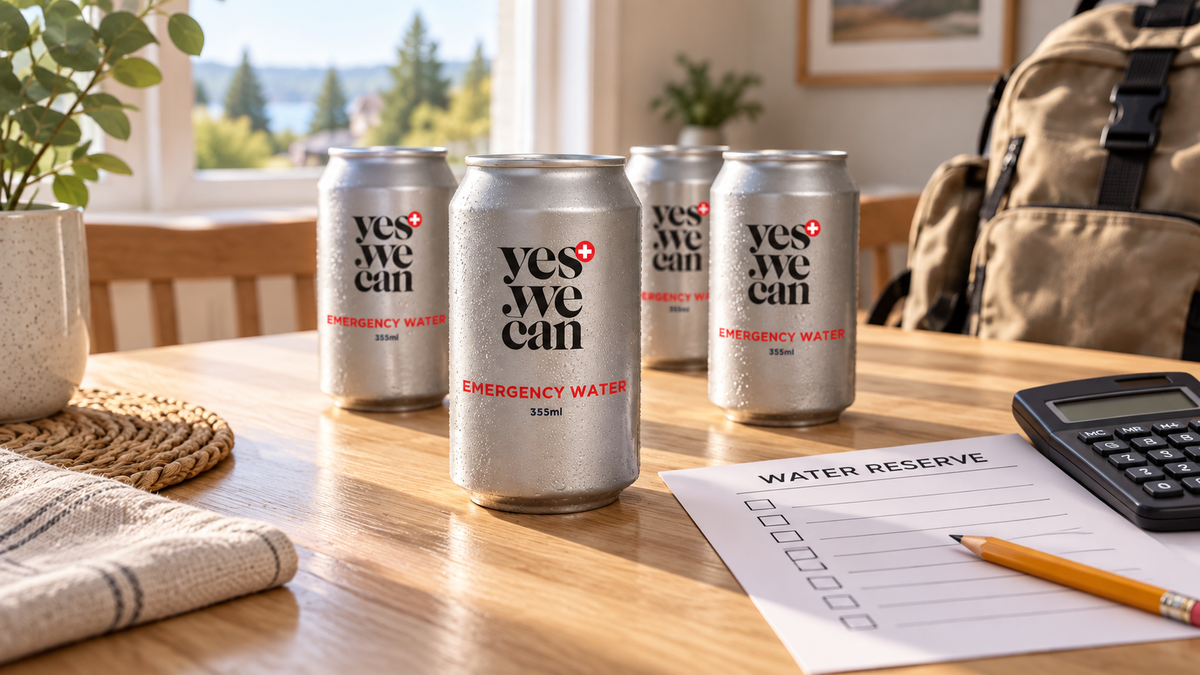
Each current Yes We Can Emergency Water can contains 355 mL, or 0.355 litres. A 12-can case holds 4.26 litres. View product details
To convert litres to cans:
Total litres ÷ 0.355 = cans required, rounded up
For one person’s basic daily planning quantity:
-
Five cans contain 1.775 litres, below the two-litre target.
-
Six cans contain 2.13 litres, meeting that target.
For household reserves, calculate from the total litres needed:
| Basic 72-hour reserve | Litres needed | Minimum whole 355 mL cans | Whole 12-can cases if buying only cases |
|---|---|---|---|
| 1 person | 6 litres | 17 cans | 2 cases |
| 2 people | 12 litres | 34 cans | 3 cases |
| 4 people | 24 litres | 68 cans | 6 cases |
| 5 people | 30 litres | 85 cans | 8 cases |
Quantities are rounded up from the total reserve volume. Whole-case purchases provide more water than the minimum can count.
These figures cover the basic two-litre planning allowance. Cooking, cleaning and other needs require additional water.
You can also combine container sizes. Count all suitable stored drinking water toward your target rather than assuming the entire reserve must use one format.
What about cooking, cleaning and pets?
Think through how your household would use water if the taps were unavailable.
Your food choices affect preparation needs. Check whether emergency meals require added water, and include essential tasks such as brushing teeth in your plan.
Pets need their own allocation. Include their usual drinking needs and ask your veterinarian for guidance if you are unsure how much to store.
Keep these additions visible in your calculation so that water intended for other tasks does not quietly reduce the amount available for drinking.
How should you store emergency water?
Choose an accessible location and follow the instructions for your containers and water products.
For water you fill and store yourself, the CDC recommends suitable food-grade containers, a storage-date label and replacement every six months. Keep it cool, away from direct sunlight and separate from chemicals. Commercially packaged water should follow its applicable dates and storage guidance. CDC water storage instructions
Yes We Can Emergency Water is purified still water sealed in aluminum cans for a managed emergency reserve. Keep unopened cases in a clean, dry, temperature-controlled location, protect cans from damage and follow the current inspection and storage instructions supplied with the product.
Make a regular check part of your household routine:
-
Confirm the total litres still match your plan.
-
Inspect packaging condition.
-
Check applicable dates and product instructions.
-
Replace anything used.
-
Make sure everyone knows where the reserve is stored.
Is one case enough for a three-day emergency kit?
One 12-can case of 355 mL water contains 4.26 litres, so it does not meet one person’s basic six-litre target for 72 hours.
Two cases contain 8.52 litres and exceed that basic target. Additional cooking, cleaning, pet and individual needs still need to be included.
Package size can make a reserve look larger than it is. Checking litres gives you a clearer picture.
Prepare your reserve around your household
Start with the people in your home, choose your coverage period and calculate the litres required. Then select the container sizes and storage arrangement that fit your space.
Explore Yes We Can Emergency Water as part of a practical reserve you can keep accessible, inspect regularly and replenish when needed.