The Storm That Shook the Caribbean
In late October 2025, Hurricane Melissa carved a devastating path across the Caribbean, making landfall in Jamaica as a Category 5 hurricane before battering Cuba and Haiti. With sustained winds reaching 185 mph (300 km/h) and rainfall exceeding 1,000 mm (40 inches) in some areas, Melissa quickly became one of the most powerful Atlantic storms in recent history.
Entire neighborhoods were inundated. Bridges collapsed, roads disappeared, and vital services were knocked offline. In the aftermath, Jamaica’s prime minister declared much of the country a disaster area, and more than half a million residents were left without access to electricity or clean water.
The human toll has been severe: by October 30, reports confirmed over 30 deaths across the region and thousands displaced from their homes.
But beyond the destruction and debris, another crisis quickly emerged—one that doesn’t always make the headlines: the sudden loss of safe drinking water.
When the Water Stops Flowing
After any major storm, access to clean water becomes one of the first and most urgent challenges. Hurricanes destroy pipes, contaminate wells, and leave filtration plants offline for days—or weeks.
In Jamaica, widespread flooding and landslides overwhelmed drainage systems and contaminated water sources. Emergency shelters reported shortages of bottled and purified water within 48 hours. In parts of Haiti and Cuba, residents were forced to collect rainwater or resort to unsafe wells, risking outbreaks of waterborne diseases.
This pattern repeats after almost every major storm. When infrastructure fails, water quickly becomes a precious commodity—proving that preparedness is not just about surviving the storm, but enduring the days and weeks that follow.
The Silent Emergency: Safe Water as a Lifeline
The World Health Organization emphasizes that during emergencies, each person needs at least 2 to 3 litres of safe water per day for hydration alone—not including sanitation or cooking. Yet most households and institutions are not prepared to store even one week’s supply.
Hurricane Melissa demonstrated that even middle-income countries can find themselves vulnerable when their systems collapse. From Kingston’s urban core to rural coastal villages, access to safe drinking water became a shared struggle.
As climate change drives warmer oceans and more intense storms, this problem is growing. Hurricane Melissa’s rapid intensification—from a tropical storm to a Category 5 hurricane in less than 48 hours—was fueled by record-high sea-surface temperatures in the Atlantic.
That means communities have less time to prepare, and the need for ready-to-use emergency water supplies becomes all the more urgent.
4. How Yes We Can Emergency Water Helps Communities Prepare
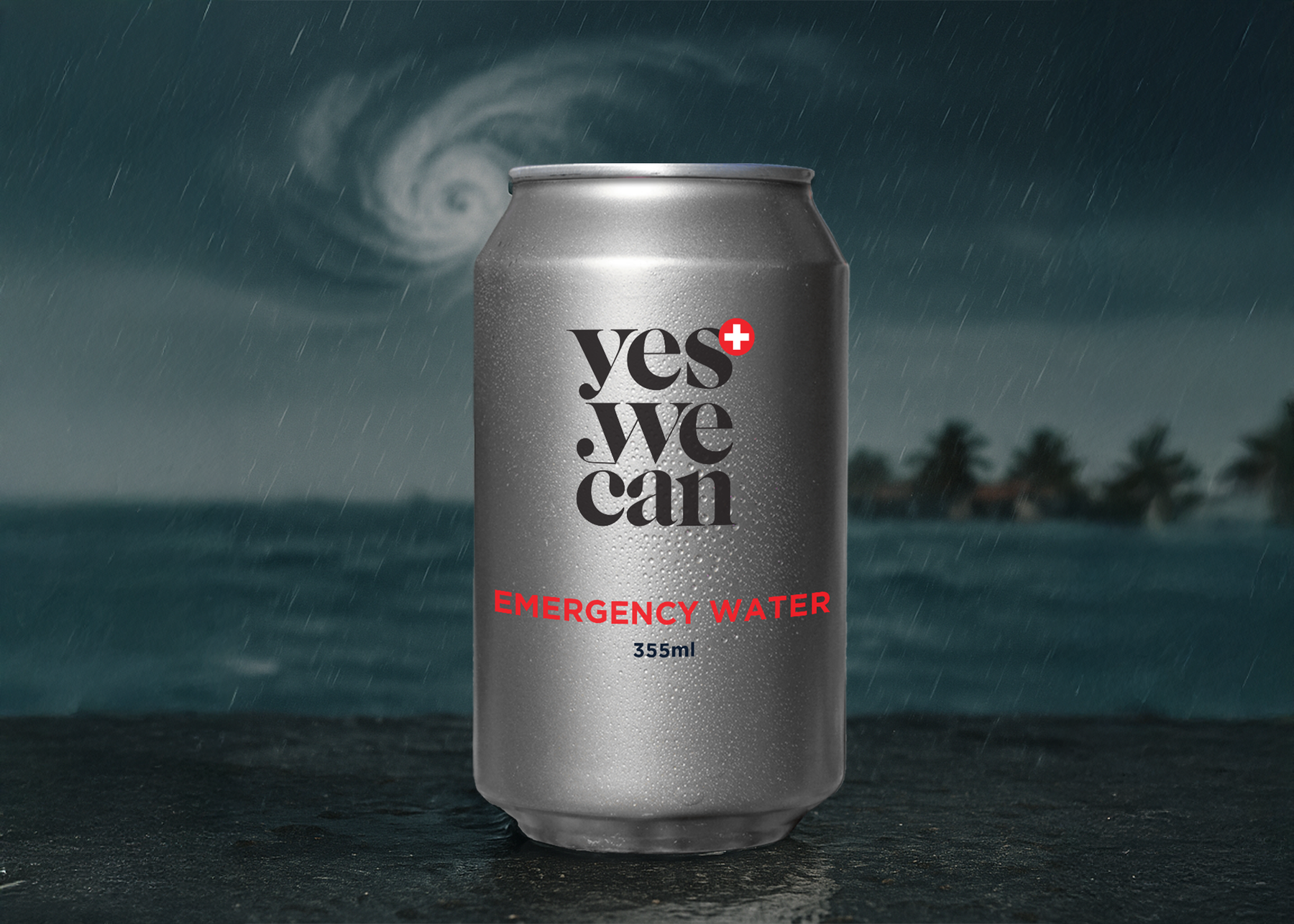
At Yes We Can Drinks, we built our emergency water program on a simple premise: when systems fail, safe drinking water should still be available.
Each can of Yes We Can Emergency Water is:
-
Hermetically sealed in recyclable aluminum, keeping it airtight and contamination-free.
-
Filtered through a multi-stage process—carbon, sediment, and reverse osmosis.
-
Sterilized with UV light and ozonation before being nitrogen-infused to maintain long-term freshness.
In short: whether stored in emergency management depots, NGO warehouses, or household preparedness kits, Yes We Can Emergency Water is designed to endure the unexpected.
The Growing Market for Resilience
While no company should ever profit from disaster, preparedness is an investment that saves lives, reduces recovery costs, and strengthens community resilience. The global emergency-preparedness market—spanning shelf-stable food, water, medical, and power solutions—is expected to grow dramatically over the next decade, driven by:
-
More frequent extreme weather events across North America, the Caribbean, and Asia.
-
Government mandates requiring stockpiles for emergency response agencies.
-
Corporate continuity planning, as businesses ensure operations can continue after natural disasters.
-
Consumer awareness, with households increasingly building personal emergency kits.
Our company has witnessed this shift firsthand. From municipal buyers to international NGOs, institutions are prioritizing products that combine quality, long shelf life, and verified safety standards.
Hurricane Melissa serves as a real-world reminder that water security is now a frontline issue—and that scalable, sustainable solutions are vital.
Canada’s Contribution to Global Preparedness
As a Canadian producer of emergency water, Yes We Can Drinks is proud to contribute to global resilience. Our facility operates under GMP and HACCP certifications, is registered with the CFIA and FDA, and follows a rigorous process tested in collaboration with Canadian universities.
Our production reflects the best of Canadian innovation: reliable, safe, and environmentally conscious. Aluminum cans are infinitely recyclable, lightweight, and resilient to both heat and cold—making them ideal for transport and long-term storage in emergency conditions.
Whether for disaster-prone regions like the Caribbean, or emerging markets building national reserves, Canada’s water-security expertise can play a central role in ensuring no community faces a water crisis alone.
Lessons from Hurricane Melissa
Melissa’s devastation has been a painful lesson, but it also offers a roadmap:
-
Pre-position emergency supplies. Stockpiles should be strategically located to reach affected areas quickly after a storm.
-
Invest in shelf-stable drinking water. Unlike plastic bottles, sealed aluminum cans can endure heat, cold, and time without compromising quality.
-
Educate the public. Families should know how much water to store and how to rotate their supplies annually.
-
Empower local production. Partnering with regional bottlers and canners strengthens self-reliance before disasters strike.
Preparedness doesn’t happen overnight—it is built can by can, case by case, with the same patience and foresight that communities use to rebuild.
Why “Yes We Can” Means More Than a Name
The inspiration for Yes We Can Emergency Water came during the pandemic and in the wake of repeated natural disasters. Empty supermarket shelves and boil-water advisories revealed a universal truth: resilience begins at home.
Our name reflects both a promise and a philosophy: Yes, we can be ready. Yes, we can protect our families and communities. And yes, we can build a future where clean water is never out of reach.
Each can is more than a product—it’s a quiet assurance that in a world of uncertainty, preparedness remains within reach for everyone.
The Road Ahead: Building a Culture of Readiness
The path forward demands collaboration among governments, private companies, NGOs, and everyday citizens. As storms intensify and climate models project a rise in Category 4 and 5 hurricanes, water resilience will define how well societies adapt.
By investing in long-term emergency water solutions, we can reduce the humanitarian toll of disasters, strengthen global supply chains, and bring peace of mind to families everywhere.
Melissa will not be the last storm of its kind—but it can be a turning point in how the world prepares for what comes next.
Final Thoughts – Yes We Can Be Prepared
From Kingston’s flooded streets to relief camps across the Caribbean, Hurricane Melissa reminded us how fragile water access can be—and how vital preparation is.
At Yes We Can Drinks, we remain committed to ensuring that safe, shelf-stable drinking water is accessible when people need it most. Whether you are an emergency manager, a humanitarian organization, or simply a homeowner who believes in being ready—now is the time to act.
Because when the taps stop, preparedness starts.
Yes We Can Be Prepared.