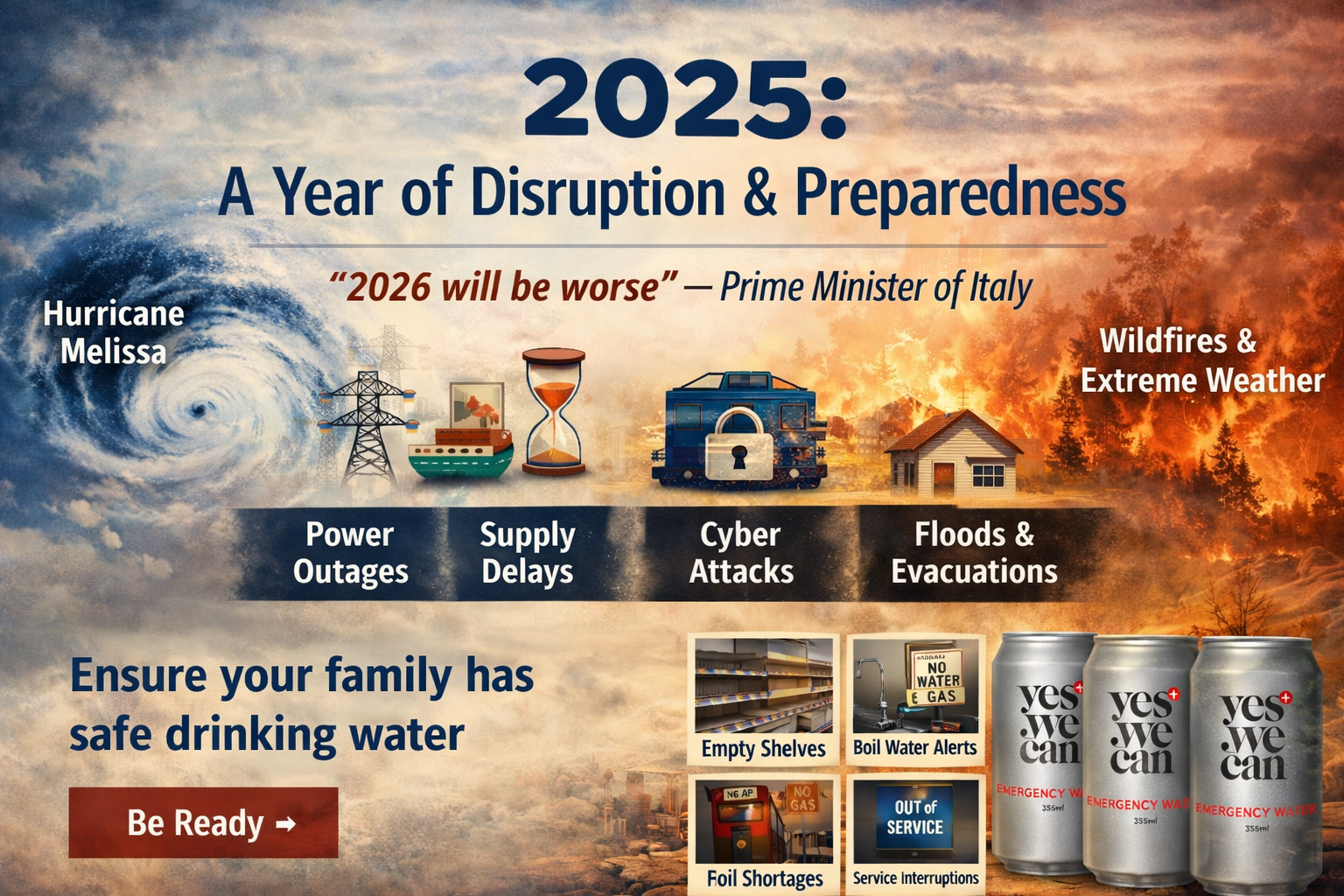
At the end of 2025, people around the world weren’t just scrolling through year-end headlines — they were reviewing what actually happened to them.
Maybe your power flickered during an unexpected outage.
Maybe your favorite product vanished from the store shelves.
Maybe that storm knocked out electricity longer than expected.
Maybe your town issued a water advisory after heavy rain.
Maybe internet, banking, or transit systems hiccupped.
And somewhere in all of this — in living rooms, kitchens, and workplaces — everyday people realized a simple truth:
Life doesn’t pause for disruptions — and neither do your needs.
This year was marked not only by extreme weather events, but by a series of interruptions that were visible, relatable, and talked about online and on the news.
“2025 Was Difficult — 2026 Will Be Worse”
A Remark That Struck a Chord
In her year-end address, Italy’s Prime Minister Giorgia Meloni said something that resonated far beyond politics:
“The end of 2025 has been difficult — and 2026 will be worse.”
Source: https://nypost.com/2025/12/24/world-news/italian-pm-giorgia-meloni-the-end-of-2025-has-been-difficult-next-year-will-be-much-worse/
You didn’t need to follow international politics to feel what she meant. Millions of everyday people felt it in their routines — not because of fear, but because 2025 reminded us how fragile so many systems really are.
Disruptions That Actually Affected Daily Life in 2025
🌪 1. Extreme Weather Events
Hurricane Melissa — one of the strongest Atlantic hurricanes on record — caused prolonged power outages and infrastructure stress in affected communities.
Source: https://en.wikipedia.org/wiki/Hurricane_Melissa
Record heatwaves and wildfires forced evacuations and air-quality alerts in cities where families struggled to keep loved ones safe indoors.
🔌 2. Power Grid Stress and Public Infrastructure Outages
Several regions experienced extended power outages not tied to storms — often due to aging grids, equipment failures, or unexpected surges. People reported:
-
No charging stations for phones
-
Refrigerators warming up
-
Water pumps losing pressure
💻 3. Cyber-Related Service Interruptions
In multiple countries, temporary outages to banking apps, transit systems, and government portals made it harder to pay bills, access services, or track shipments.
📦 4. Supply Chain Delays and Empty Aisles
Even outside disaster zones, people noticed:
-
Favorite products missing from shelves
-
Longer delivery windows for groceries and essentials
-
“Out of stock” messages online that lasted days or weeks
These weren’t fringe experiences — they were central to people’s everyday routines.
🚗 5. Transportation Hiccups
Train delays, airport backups, and regional travel advisories — especially during peak holiday seasons — left families stranded or waiting longer than expected.
Real People, Real Interruptions: What Felt Different in 2025
Here are the types of disruptions that real people talked about on forums, social media, and in everyday life:
-
The 7 p.m. power outage that lasted until the next afternoon
-
Boil-water advisories after heavy rain even in mid-latitude cities
-
Grocery shelves lacking bottled water and pantry staples
-
Two-week delivery estimates for items that used to arrive in three days
-
Smartphone app outages when trying to pay for groceries
-
Long weekend travel backups because of a rail signal outage
These weren’t “abstract possibilities” — they were lived experiences.
You Don’t Notice Water Until You Need It
If there was one takeaway people consistently mentioned in 2025, it was this simple truth:
Water is invisible — until it’s not.
In everyday life, water is used for:
-
Drinking
-
Making coffee or tea
-
Cooking
-
Washing hands
-
Brushing teeth
-
Caring for babies and pets
-
Medication
And when municipalities issue advisories such as “boil water before drinking,” most families feel the impact immediately.
According to the U.S. Centers for Disease Control and Prevention (CDC):
People can survive weeks without food,
but usually only a few days without water.
Source: https://www.cdc.gov/healthywater/emergency/drinking/emergency-water-supply-storage.html
That’s why having clean emergency water ready before a disruption is such a practical part of planning.
Emergency Water: Practical, Not Panic-Driven
At Yes We Can, we think about preparedness in everyday terms:
✔ Not about fear
✔ Not about survival bunkers
✔ Not about apocalypse thinking
✔ But about continuity, peace of mind, and readiness
Preparedness is what lets you:
-
Brew coffee on schedule
-
Cook dinner without worrying about drought or advisories
-
Give your kids water you trust
-
Help a neighbour who didn’t think ahead
Emergency Water vs. Standard Bottled Water
One common misunderstanding is that regular bottled water and emergency drinking water are the same.
They are not.
Standard bottled water is:
-
Designed to be consumed regularly
-
Often sold with short turnover in stores
-
Not intended for long-term storage
Emergency drinking water (like Yes We Can) is:
-
Packaged to remain safe when stored
-
Designed for readiness when systems fail
-
Meant to be part of a household plan
Consumers and emergency planners agree that water stored at home independently of retail availability is the most reliable option when normal systems pause.
Source: https://www.ready.gov/water
DIY Water Storage? Yes — and Here’s How
Not everyone can or wants to store cases of branded emergency water — and that’s okay. You can supplement with DIY water storage as part of a practical plan.
Here’s how:
✔ Choose the Right Containers
Food-grade water storage containers or BPA-free jugs are best.
✔ Know How Much to Store
Experts recommend:
-
At least 1 gallon per person per day
-
For 3–7 days minimum
Source: https://www.cdc.gov/healthywater/emergency/drinking/emergency-water-supply-storage.html
✔ Store Water in a Cool, Dark Place
✔ Rotate Regularly
Even stored water should be refreshed:
-
Every 6–12 months
-
Or according to container guidance
✔ Mark the Date
Label each container with the storage or rotation date.
This DIY approach works perfectly alongside Yes We Can Emergency Water, which is already sealed, long-term ready, and rotation-free unless you choose to rotate it.
Making Preparedness Part of Everyday Life
Preparedness doesn’t require special equipment or extreme planning. It starts with simple habits that only take a few minutes:
-
Assess what you already have.
Look in your pantry and fridge: how much water could you rely on if tap water were uncertain for a few days? -
Decide what you want covered.
Everyone’s needs are different — kids, elders, pets, medications, climate considerations. -
Supplement with Yes We Can Emergency Water.
Keep a core stock that you know will be ready without rotation. -
Create a small plan.
Not a bunker. A list: where water is stored, how long it has been there, and a simple replacement schedule.
Why 2025 Was Meaningful — and What That Means for You
The disruptions of 2025 weren’t just weather events — they were everyday interruptions that gave ordinary people a glimpse of what happens when systems pause.
From Hurricane Melissa and record heatwaves, to supply chain delays and power grid stress, the common thread was this:
Normal life depends on systems we take for granted.
When those systems strain, we realize:
-
We want continuity
-
We want reliability
-
We want stability for our loved ones
Preparedness doesn’t mean expecting disaster — it means planning for the interruptions we already know happen.
Yes We Can Emergency Water — Your Everyday Readiness Partner
Yes We Can exists for people who:
-
Want peace of mind, not panic
-
Value continuity over uncertainty
-
Appreciate products that are practical, reliable, and ready
Yes We Can Emergency Water:
-
Is sealed for storage
-
Requires no complex preparation
-
Is designed to be there when normal water sources pause
Because real life doesn’t wait for perfect conditions.
Frequently Asked Questions (SEO Boost)
Is emergency water only for disasters?
No. It’s for any interruption — storms, outages, advisories, travel delays, or supply gaps.
How much emergency water should I store?
At least 1 gallon per person per day for 3–7 days minimum.
Source: https://www.cdc.gov/healthywater/emergency/drinking/emergency-water-supply-storage.html
Can I store my own water?
Yes. Food-grade containers + cooldown rotation make DIY water storage a practical supplement.